Half-Pipe Protocol
Strategy with an explicit understanding of gravity
Prologue
Part I
Part II
Part III
Appendix
Prologue
The Chair at the Lip
The room had that particular kind of quiet: less peace than compression. Everyone was present, but not everyone was calm. The numbers were fine. The pipeline was fine. The product was, by any reasonable measure, more than fine.
And yet the landscape outside the windows, real and metaphorical, was heaving.
AI was not “arriving.” It had arrived. The thing that used to be the future had become the present tense. Competitors were revising their contracts mid-quarter. Partners were rewriting expectations without asking. New distributors (platforms, aggregators, model providers, app stores, procurement consortia) were setting de facto norms in public, and doing it fast enough that the norms began to feel like physics rather than preference.
The board chair watched the team cycle through drafts of a plan that was, in the old world, perfectly adequate: adjust pricing here, expand channel there, renegotiate a handful of deals, keep the quarter on the rails.
But the old world had a forgiving geometry. You could hesitate and still recover. You could overpromise and still renegotiate. You could afford a few months of ambiguity while you learned.
That geometry was gone.
In a heaving landscape, strategy behaves less like architecture and more like dynamics. You don’t “construct” outcomes. You ride them. You keep your balance. You preserve enough control to stay inside the system’s constraints while still moving fast enough to matter.
The chair stood and walked to the whiteboard. Not to add another framework. To reduce the entire argument to a single problem.
“There are two ways we lose,” they said. “We either fly out of the pipe, or we stall at the coping.”
Flying out looked like this: promising a pricing posture we cannot settle operationally; granting partners control rights we cannot claw back; letting expectations outrun capacity; shipping commitments that become precedent; moving so fast that the exceptions become the system.
Stalling looked like this: perfect internal certainty, no external learning. Waiting for the market to settle while the market is being settled by other people.
A board does not exist to pick between panic and paralysis. A board exists to insist on disciplined motion.
The chair drew a half-pipe.
On one side, the deck: reserves. Cash, capacity, credibility, relationships, optionality. All the stored energy a company accumulates when it does the unglamorous work of being reliable.
Then the drop-in: the moment when private intent becomes public commitment.
Down the transition: where handoffs happen and energy is lost. Sales to delivery, product to support, marketing to reality, promise to settlement.
Then the other wall and the lip, the coping: the boundary that keeps speed from becoming ejection. The place where you can do something dramatic, if you have the technique to re-enter.
And finally, re-entry: not a flourish, but a conversion. The moment when the peak becomes routine. When a sprint becomes an operating system.
The chair turned back to the room.
“We are deciding a distribution change in a world where distribution is being rewritten. That means we are not deciding a slide deck. We are deciding a run.”
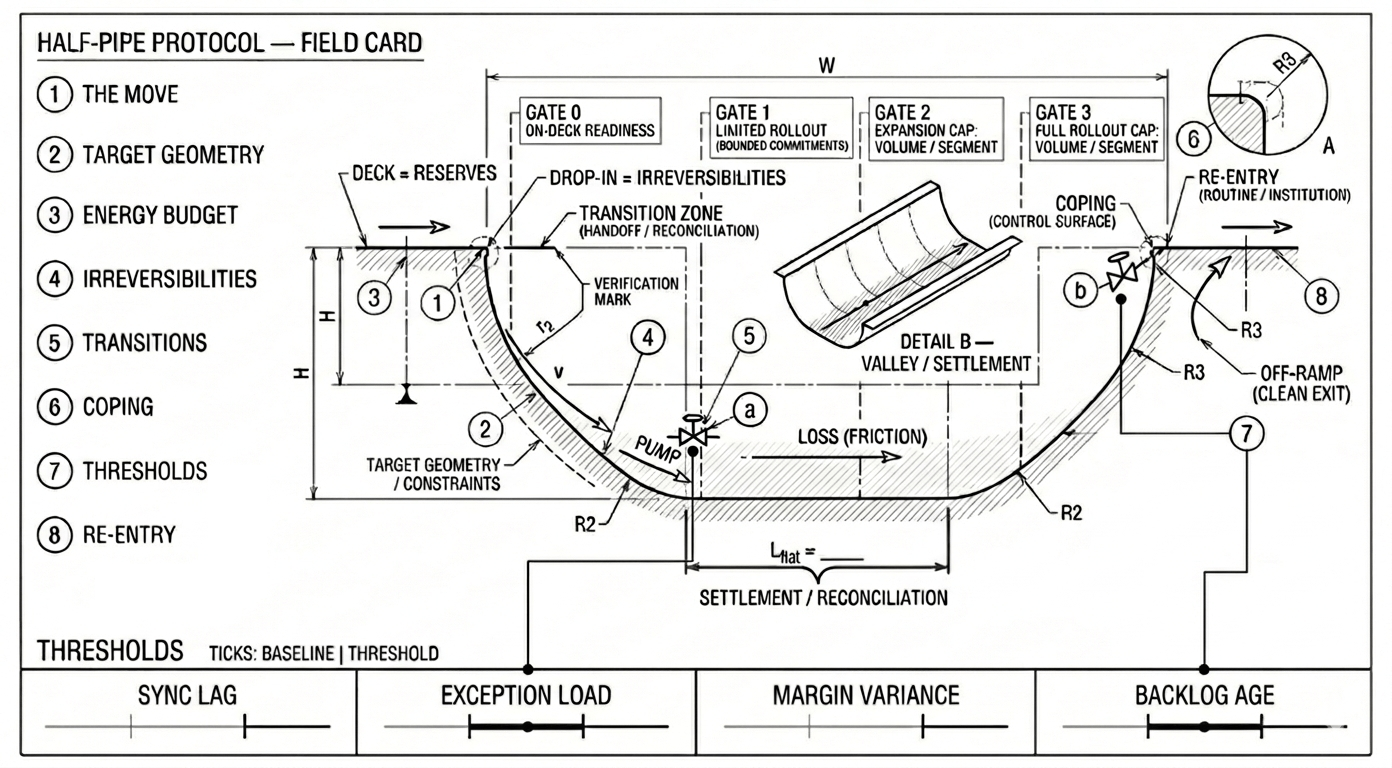
Then they wrote eight prompts beneath the drawing. A field card for adults who have to move while the ground is moving.
Not rules. Not slogans. Prompts you cannot answer lazily.
1) The Move • 2) The Target Geometry • 3) The Energy Budget • 4) The Irreversibilities • 5) The Transitions • 6) The Coping • 7) Thresholds • 8) Re-entry
“Answer these,” the chair said, “and we can go fast without leaving the pipe. Refuse them, and the market will answer them for us.”
This is the Half-Pipe Protocol: a repeatable way to convert reserves into commitments, and commitments back into renewed reserves: without crashing, and without freezing.
It is strategy with an explicit understanding of gravity.
Part I
Boardwork in a Heaving Landscape
A board is not an idea factory. It is a physics committee.
Not because it should micromanage operations, but because its core obligation is to insist that commitments be matched by control rights, and that control rights be supported by operating reality. In stable times you can blur these distinctions and survive. In heaving times, you cannot.
The board’s job, in Half-Pipe terms, is to shape curvature.
Curvature is constraint. It is the set of gates, throttles, and verification steps that prevent momentum from becoming ejection. Curvature is what allows speed to compound.
When distribution is stable, a company can treat it as a channel. When distribution is being rewritten, distribution becomes an environment. It has its own emergent norms: what customers expect by default, what partners assume is negotiable, what procurement systems enforce, what platforms make “one click,” what the market interprets as fair.
And if you are not careful, your pricing becomes a rumor you can’t correct.
So the board chair does not ask, “How do we win?” The chair asks: “What commitments are we about to make that we will not be able to unwind once the market internalizes them?”
The Half-Pipe Protocol turns a board discussion into a disciplined run.
Prompt 1
The Move
One sentence, clean enough to repeat outside the room without changing its meaning. If it takes a paragraph, it’s not a move; it’s a mood. A move is a commitment that displaces something else. It has a surface area. It has opponents. It has consequences.
Prompt 2
The Target Geometry
Before you debate speed, you decide shape. What must be constrained for this move to be stable? Where must the wall be tight: narrow scope, bounded promises, narrow eligibility, hard caps? Where must the wall be open: optionality, modularity, reversible components, room to learn? A board that can’t articulate target geometry will default to a geometry chosen by deal pressure, partner incentives, and quarter-end adrenaline.
Prompt 3
The Energy Budget
Every distribution shift spends reserves. Cash is obvious. Credibility is subtler. Capacity is always the hidden constraint. In a heaving landscape, credibility is a spendable asset and a fragile one. If you promise a norm and fail to settle it reliably, you don’t merely lose a customer; you teach the market that your norms are not norms. The board forces the question: which reserves are we willing to spend, and which must remain protected? If everything is spendable, nothing is protected. That is how companies “move fast” into fragility.
Prompt 4
The Irreversibilities
The drop-in is not the launch date; it’s the first moment the world begins updating its beliefs about you. Irreversibilities include:
- Public pricing pages and “default” contracts
- SLAs
- Partner terms that grant control rights
- Precedents that sales will cite forever
- Any promise that customers start building into their own systems
Boards often treat irreversibility as a legal issue. It is an operational and reputational issue. The relevant question is not “Can we reverse this?” but “What will it cost, and will we pay that cost when the time comes?”
Prompt 5
The Transitions
Most companies do not fail because they lack ambition. They fail because they bleed energy in the transition zone.
Transitions are handoffs:
- Sales to delivery.
- Delivery to support.
- Product promise to incident response.
- Billing to collections.
- Partner-led onboarding to customer trust.
When you change distribution, you change which transitions are stressed first, and which transitions become existential.
The board does not need to design these handoffs, but it must insist they are named, owned, and instrumented. If a transition is “everyone’s problem,” it becomes no one’s. If no one owns reconciliation, exceptions become policy.
Prompt 6
The Coping
Coping is the boundary that makes speed safe. In business, coping is not a memo about “being careful.” It is a control surface:
- Gates: stage boundaries with entry and exit criteria
- Throttles: automatic slowdowns based on leading indicators
- Verification: mechanisms that keep claims tethered to reality
- Off-ramps: reversible modules, clean exits, public narratives that preserve credibility
The board asks a question that sounds almost naive: who can pull the throttle without asking permission? If the answer is “no one,” the company will accelerate until it hits the wall.
Prompt 7
Thresholds
You cannot ride dynamics by watching lagging indicators. Revenue comes after commitment. Churn comes after disappointment. Reputation damage comes after the screenshots. Thresholds are a small set of leading indicators that predict ejection before the market sees it:
- Implementation sync lag
- Exception load
- Support backlog aging
- Margin variance relative to promised pricing
- SLA breach rate
- Dispute and chargeback rates where relevant
The board insists on thresholds and automatic actions. Not because it distrusts management, but because discipline must survive fatigue.
Prompt 8
Re-entry
Finally: re-entry is where maturity lives.
If the move works, what becomes routine? What ownership model persists when the launch team dissolves? What cadence turns novelty into reliability?
And if it fails, how do we exit cleanly without a credibility crater? What is the earliest moment we will admit the truth and reduce exposure?
Re-entry is not a concession. It is how you preserve the deck.
Because the point is not to do one impressive trick. The point is to keep riding.
Part II
The Founder’s Wedge
Founders are often described as dreamers. In practice, the best founders are transition engineers.
They don’t merely imagine a product. They locate a place in the incumbent system where energy is being wasted, predictably and structurally, and they build a wedge that converts that waste into advantage.
Half-Pipe Protocol gives the founder a competitive lens: incumbents are not beaten by their slogans, or even by their features. They are beaten where their geometry cannot tighten.
Start with the incumbent’s pipe.
Where do they store energy? Brand. Installed base. Procurement trust. Existing distribution. Sales motions that have been trained by repetition.
Where do they spend it? Every promise they make to keep customers from leaving; every discount given to preserve volume; every exception granted to close a deal.
Where are their irreversibilities? Public norms they cannot retreat from without looking weak; contract structures that assume old cost curves; partner ecosystems that demand certain concessions.
And then: where are their transitions?
This is the founder’s map. Look for the handoff where the incumbent’s speed is purchased by hidden debt.
Common transition failures:
- Reconciliation: the system can promise, but cannot settle. The exceptions are too expensive to resolve at scale.
- Latency: the time from “yes” to “value” is long enough that trust evaporates.
- Accountability diffusion: too many teams touch the customer, so no one owns the outcome.
- Overfitted distribution: the channel is optimized for yesterday’s buyer and cannot adapt quickly without breaking its own assumptions.
The wedge is rarely glamorous. It is often a narrower promise, settled with higher integrity.
A founder using Half-Pipe Protocol asks the same eight prompts, with a competitive lens:
Prompt 1
The Move
What is the smallest commitment we can make that changes the customer’s default behavior?
Prompt 2
The Target Geometry
Where will we be tighter than the incumbent: narrower scope, clearer bounds, cleaner settlement? Where will we be open: modular integrations, reversible adoption, low switching friction?
Prompt 3
The Energy Budget
What reserves do we actually have? Time. Talent. Conviction. A small amount of credibility that must be spent carefully.
Prompt 4
The Irreversibilities
What claim are we making that will define us? What norm do we teach the market to expect from us?
Prompt 5
The Transitions
Which transition are we choosing to own end-to-end? If we do not own a transition, we are building on someone else’s curvature.
Prompt 6
The Coping
How do we prevent growth from outrunning our ability to settle? What is our throttle? What is our gate? Who pulls it?
Prompt 7
Thresholds
What will tell us early that our wedge is failing: sync lag, exception load, reliability cliffs, customer confusion?
Prompt 8
Re-entry
If we are right, what becomes routine? If we are wrong, what do we preserve so we can try again without destroying trust?
This lens also predicts incumbent response. Incumbents rarely respond by fixing transitions first. Fixing transitions is expensive and organizationally painful. It requires rewriting accountability and sometimes rewriting who has power.
They respond by pumping harder on the wall they already have:
- Marketing.
- Bundling.
- Discounts.
- Announcements.
- Partnerships designed to signal strength.
This can work temporarily. But it increases speed without improving curvature, and so it increases crash risk.
The founder does not need to win the entire pipe. They need to win one transition and make the market feel the difference between a promise and a settled promise.
In heaving landscapes, that difference becomes decisive.
Because the future belongs to the systems that can commit cleanly and re-enter reliably. Not the systems that merely accelerate.
Part III
The President’s Coping
The new president inherited a world that moved too fast for the rituals that once stabilized it.
An incident arrives in the early hours. It is not yet a crisis, but it is already a test.
Signals are imperfect. Advisers disagree. Opponents posture. Allies seek reassurance. Media demand a story before there is enough truth to deserve one.
In older eras, leaders could buy time with ambiguity. In this era, ambiguity is interpreted as weakness, and weakness invites miscalculation. And yet speed without curvature is escalation.
Half-Pipe Protocol offers statecraft a discipline: make pressure legible, bounded, conditional, and reversible, while preserving enough momentum to deter opportunism.
The president’s reserves (the deck) include:
- Legitimacy at home.
- Cohesion among allies.
- Military readiness.
- The credibility of commitments already made.
The irreversibilities (the drop-in) include:
- Public red lines.
- Moves that force the adversary to respond for domestic reasons.
- Actions that lock allies into positions they did not choose.
Transitions, the energy loss zones, are everywhere:
- Intelligence to public narrative.
- Public narrative to coalition alignment.
- Coalition alignment to operational execution.
- Execution to restraint when the crowd wants spectacle.
Coping, here, is the highest craft. The president does not try to “look strong” in the abstract. They try to control geometry.
They announce not a verdict, but a sequence. A bounded run:
- In the next six hours, specific verification steps.
- In the next forty-eight hours, specific diplomatic contacts.
- In the next two weeks, specific conditions under which pressure escalates or relaxes.
The point is not to perform certainty. The point is to design re-entry.
The president establishes:
- Gates: thresholds that determine whether the next step is taken
- Throttles: automatic slowdowns when signals are ambiguous or coalition alignment weakens
- Verification: mechanisms that reduce the opponent’s incentives to bluff and reduce domestic incentives to overreact
- Off-ramps: paths the adversary can take without humiliation, so that retreat is possible without escalation
This is not softness. It is control.
Thresholds are political as much as military:
- Ally cohesion.
- Domestic trust.
- The adversary’s internal pressures.
- Information integrity: how fast false narratives are spreading, and whether they are forcing choices prematurely.
Re-entry is the end state: turning the incident into a strengthened mechanism rather than a one-off performance.
If the president succeeds, the public does not merely feel relieved.
They feel that the system has curvature.
That the country can move fast without flying out of the pipe.
Because the danger in modern politics is not only the adversary.
It is the internal acceleration of commitment-making without settlement, without verification, without off-ramps.
Half-Pipe Protocol is a way to treat statecraft as dynamics rather than theater.
A way to build coping high enough that speed does not become ejection.
A way to preserve the deck.
Appendix A
Half-Pipe Protocol Field Card
The minimum viable substrate for any major distribution or pricing move in a heaving landscape:
1
The Move
One sentence: what commitment or change are we making, for whom, and what does it replace?
2
The Target Geometry
Where must we tighten curvature (bounds, caps, eligibility, constraints)? Where do we preserve open wall (optionality, modularity, reversibility)?
3
The Energy Budget
What reserves are we spending (cash, capacity, credibility)? What reserves must remain protected to keep the system stable?
4
The Irreversibilities
What becomes hard to unwind once we drop in (public promises, contract terms, partner control rights, precedent)?
5
The Transitions
Where will energy be lost (handoffs, reconciliation, coordination, latency, exceptions)? Which transition is the first-break point, and who owns it?
6
The Coping
What gates, throttles, verification steps, and off-ramps keep us inside the pipe? Who can pull the throttle without permission?
7
Thresholds
Which 3 to 5 leading indicators predict ejection or stall? What thresholds trigger automatic action?
8
Re-entry
If it works: what becomes routine and institutional? If it fails: what is the clean exit path that preserves credibility, and what is the earliest moment we will admit it?